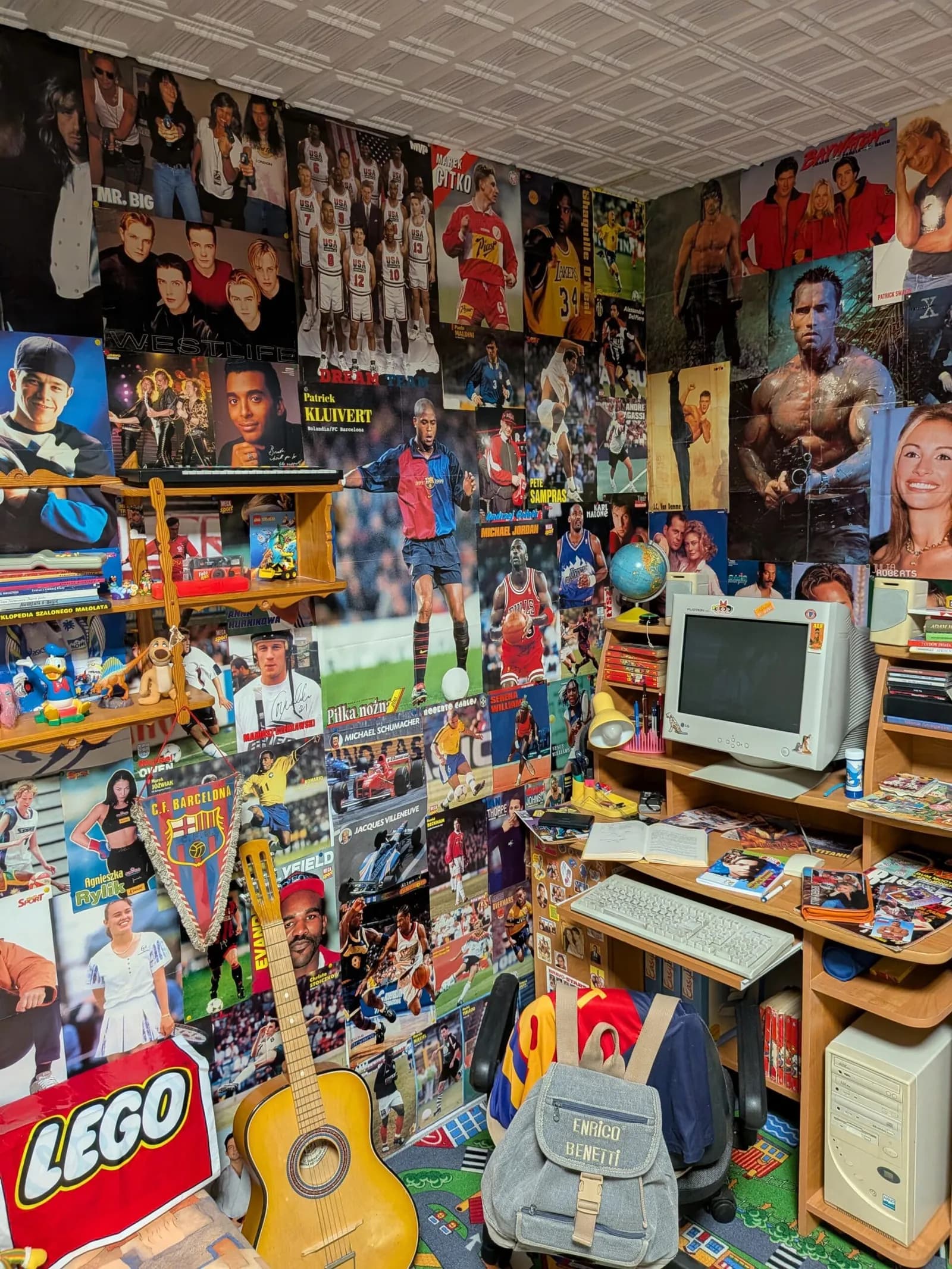
A wooden wall unit, a cassette tape and an old mobile phone can seem ordinary, until they suddenly bring an entire decade back to life.
For many people in Poland, the 1990s occupy an unusual place in memory. They were years of rapid change, when familiar routines existed alongside new possibilities arriving at remarkable speed. Television, music, fashion, computers, games and consumer goods were all changing, while a generation of children and teenagers was growing up in a country finding its way through a new political and economic reality.
In Bielsko-Biała, that experience has become the subject of a museum.
Muzeum90, located on Konstantego Damrota Street, is built around objects from everyday life in the decade. Its purpose is not simply to display old technology or childhood toys, but to preserve a more personal kind of history: the things people used, wanted, played with and lived alongside.
The museum's collection grew from a personal interest in the decade and the recognition that many apparently insignificant objects were already disappearing from everyday life. Its creators describe the project as an attempt to preserve a shared memory before those objects become increasingly difficult to find.
A decade of change, seen from inside the home
One of the most distinctive elements of Muzeum90 is its recreation of a Polish home from the 1990s.
Rather than presenting domestic life through isolated objects in glass cases, the museum brings them together. Wooden panelling, furniture, household equipment and the familiar mustard-glass drinking glasses help recreate an environment that will be immediately recognisable to many visitors who grew up during the period.
That approach matters because the history of the 1990s was not experienced only through major political events. Much of the transformation happened at home.
The arrival of new consumer goods, electronic equipment and forms of entertainment changed what families could buy and how people spent their free time. The museum's recreated interior provides a way of seeing those changes at human scale.
There is also something distinctly Polish about the objects being preserved. Items that may once have seemed commonplace, fashionable or even slightly kitsch can now reveal how quickly tastes and expectations changed during the decade.
In that sense, the exhibition is less about nostalgia for a perfect past and more about recognising how ordinary surroundings can become historical evidence.
From cassette tapes to the first mobile phones
Technology provides another thread running through the museum.
The collection includes electronic equipment from the period, as well as games consoles, computers and mobile phones. The museum also has dedicated sections covering retro games, electronics, children's culture, fashion and motoring.
For today's visitors, some of these objects can be surprisingly difficult to explain to younger generations. A mobile phone from the 1990s, for example, belongs to a world before smartphones, while cassette tapes and VHS belonged to a physical media culture that has largely disappeared.
The museum's collection reportedly includes hundreds of cassette tapes and VHS films, alongside equipment such as Walkmans, Discmans, older mobile phones and televisions.
Games offer another particularly direct connection. Visitors can encounter consoles and computers associated with titles that defined childhood and teenage entertainment during the decade.
These exhibits also illustrate how quickly technology moved. Equipment that was once considered desirable or futuristic could become outdated within only a few years.
Bielsko-Biała's newest memories are already history
There is an interesting contradiction at the heart of Muzeum90.
Museums traditionally look towards distant history, yet the 1990s are recent enough for many visitors to remember them personally. That makes the museum's role less about preserving a remote past and more about recognising that everyday history begins disappearing sooner than we expect.
The museum opened in November 2025 at Konstantego Damrota 10, giving Bielsko-Biała a cultural space devoted specifically to the decade. Local coverage of the opening highlighted its combination of domestic interiors, electronics, games, toys and motoring, including a Fiat Cinquecento.
That local setting is significant. Bielsko-Biała has a strong industrial and manufacturing identity, while its position in southern Poland also places it within a region where economic and cultural change has been particularly visible over generations. Muzeum90 adds a different layer to that heritage by looking at the relatively recent past through personal experience.
It also offers a useful reminder that cultural heritage does not always begin with monuments, historic buildings or famous figures. Sometimes it begins with the objects sitting unnoticed in a cupboard, garage or attic.
A cassette, a games console, a child's toy or a piece of furniture can carry memories that official records rarely capture. Together, they can tell us something about what people found exciting, what they aspired to own and how ordinary life felt during a period of enormous change.
That is ultimately what gives Muzeum90 its appeal beyond simple nostalgia. For those who remember the decade, it offers recognition. For younger visitors, it provides a glimpse into a Poland that was only a generation ago discovering new technologies, new forms of entertainment and new ways of living.
In Bielsko-Biała, the 1990s have therefore become more than memories. They have become something that can be walked through, examined and shared, turning the everyday objects of a rapidly changing decade into a small but revealing piece of Poland's recent history.
Visitor Information
Muzeum90
ul. Konstantego Damrota 10, Bielsko-Biała
Opening hours:
Monday to Thursday: Closed
Friday: 14:00–18:00
Saturday: 10:00–18:00
Sunday: 10:00–18:00
Admission:
Standard: PLN 34.90
Reduced: PLN 24.90